
Why KYB complexity keeps growing, and how teams can finally get ahead of it
OnboardingSep 08, 2026
For years, the recipe for strong business onboarding has been clear. Better data, broader coverage, and more automated checks. As KYB stacks have matured, many parts of the process have become easier to automate and more reliable in isolation. The hard part now is making it all add up.
Teams need to establish which data is current, and how different pieces of evidence relate to one another. Is the combined picture clear enough for the case to progress? None of this is new to experienced onboarding teams, but the scale has changed. As the volume and variety of evidence grows, the amount of interpretation increases as well.
That creates a second-order problem for mature KYB stacks. Adding more data does not automatically make the process more efficient. An extra source won't add value unless you can easily weave it into the rest of the case.
This is where some of the more credible agentic AI use cases are beginning to emerge. What we are seeing at Taktile is that AI makes the most impact in areas where the underlying information already exists, but analysts need to connect the evidence and turn it into a clear next action.
Key takeaways
- KYB complexity is growing because teams must reconcile more data, evidence, and sources across each case.
- More KYB data does not automatically mean more efficiency if analysts still need to manually connect and interpret it.
- Agentic AI is most useful when the evidence already exists but teams need help investigating, synthesizing, and deciding what happens next.
- Early use cases include adverse media reviews, ownership resolution, licensing checks, and application completeness.
- The best place to start is with one bounded KYB problem that has clear evidence requirements, outcomes, and escalation rules.
- Successful agentic KYB workflows still require human oversight, monitoring, and ongoing tuning.
The cost of complexity is easy to hide
As KYB stacks become richer, the cost of coordinating each additional source cost rarely appears as a single bottleneck. It accumulates across the process. Narrow discrepancies can trigger costly, time-consuming reviews with no material benefit.
For complex business customers, those costs can become significant. Complexity and risk do not necessarily scale together, yet operational effort often does. A business with a more involved ownership structure, geographic footprint, or documentary history may therefore become expensive to onboard well before it becomes difficult to accept from a risk perspective.
That distinction matters because it changes where the next efficiency gains are likely to come from. Once the core checks are already automated, a growing share of the opportunity sits in one place: making it cheaper to turn existing evidence into a resolved case.
Where agents are already useful
Some of the clearest early use cases for agents in KYB share a common structure. Most of the evidence needed to resolve the task is already available, and the desired outcome can be defined.
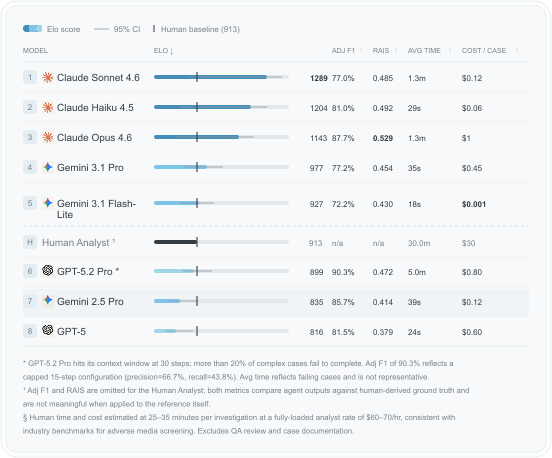
Adverse media investigation is a good example. Taktile Labs’ KYBench tested AI agents on this task across 47 businesses and 183 agent runs. On an independent 20-point rubric covering evidence completeness, entity precision, source quality, and risk calibration, human analysts averaged 13.50 and AI agents averaged 14.60.
Yuliya Kazakevich’s experience at Cash App provides a second example from KYB. Her team used LLMs to flag products that might require additional licensing checks, then used an agent to run business-entity checks, retrieve relevant licensing data, and generate a pre-filled narrative for operations. According to Yuliya, the combined approach reduced KYB case time by about 70%.
The workflows are different, but the underlying opportunity is similar. In both cases, the information largely exists already; the operational burden comes from turning it into a usable, reviewable answer.
The same principle can extend to other parts of onboarding. An ownership-resolution agent can review registry information and customer documents to construct an ownership picture and surface inconsistencies. An application-completeness agent can assess incoming evidence before the case reaches an analyst queue, identifying gaps early enough to resolve them upstream.
For teams deciding where to deploy agents first, that suggests a relatively specific test:
- Is the evidence largely available?
- Can the required outcome be clearly defined?
- Does a large share of the current effort sit in investigation and synthesis?
The operating model matters as much as the task
Identifying the right task is only part of the opportunity. Evidence also suggests that agent performance is highly sensitive to how the investigation itself is designed.
The KYBench showed that performance can vary based on how the investigation is set up, including the search strategy and prompt design. That makes the design of the workflow, evidence requirements, and escalation rules a core part of how the agent performs in practice.
Flora Zhang’s experience running AI-driven onboarding at Brex makes a similar point from production. Her team mapped the sequence of onboarding checks, determined where humans or agents should be involved, and built the surrounding architecture around those choices. As the system matured, the work shifted toward monitoring, tuning, and maintaining performance rather than treating deployment as a finished project.
As Flora puts it:
“Equally important is all the maintenance: keeping the program evolving on itself…and constantly delivering the ideal production result.”
For KYB teams, that changes what a good first use case looks like. The relevant question is not simply whether an agent can reach the right outcome. Successful teams will assess if it’s using appropriate evidence, behaves consistently across similar cases, escalates uncertainty, and remains observable enough to understand why a case progressed or stopped.
Those controls are part of the capability itself.
A credible path starts with one bounded problem
For banks exploring agentic onboarding, a useful starting point is therefore a problem whose contours are already well understood and whose outcome can be evaluated with precision.
That might be a recurring adverse-media investigation, a beneficial-ownership discrepancy, or another category of review where the team already understands the evidence requirements and what constitutes a satisfactory resolution.
A narrow problem creates a better testing environment because the boundaries can be made explicit: what evidence the agent may use, the conditions under which a case can progress, what should trigger further investigation, and the point at which uncertainty should return the case to a reviewer.
Running the agent alongside the existing process then allows teams to compare more than final outcomes. Evidence selection, consistency, escalation behaviour, and the quality of the next action can all be evaluated directly.
A successful first use case therefore provides more than one automated workflow. It gives the team empirical evidence about where agentic investigation is reliable in its own operating environment, what controls are required around it, and which adjacent use case is sensible to tackle next.
Over time, those capabilities can begin to connect. The output of an ownership investigation may inform a later screening decision; an application-completeness agent may remove avoidable gaps before downstream review; a research agent may resolve an issue before the case ever enters an analyst queue.
A more agentic KYB flow can emerge from that progression, with each capability earning its place through a bounded, measurable use case first.
For teams trying to get ahead of growing KYB complexity, the more durable question is where abundant evidence is still generating disproportionate resolution cost, and whether an agent can reduce that burden reliably.