AI 5 min read
AI upskilling: Yuliya Kazakevich on how to activate AI’s three core layers in KYB decisions

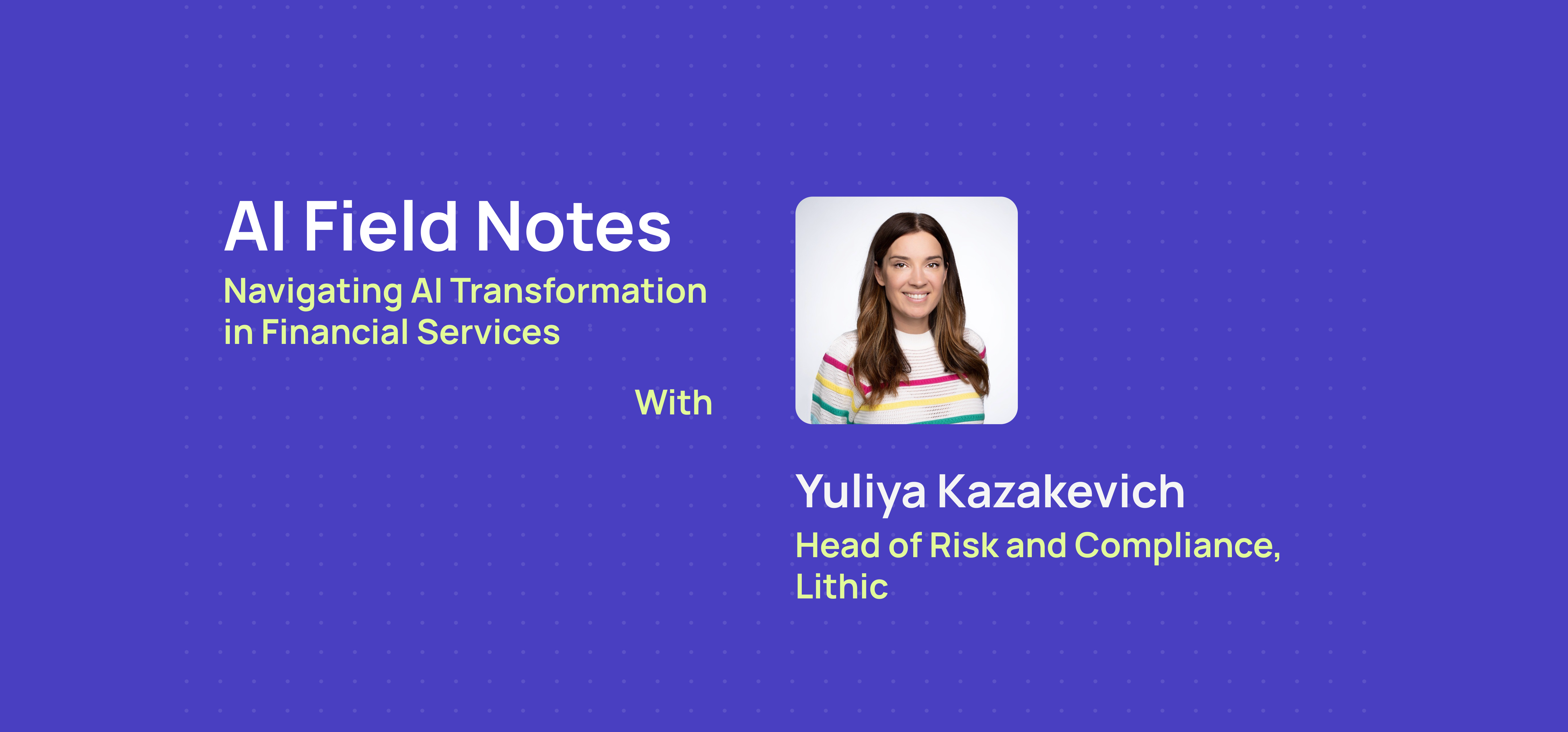
Yuliya Kazakevich is a proven powerhouse in risk and compliance, from leading teams at Apple to holding top positions at financial institutions such as Adyen and Cash App. Now, Yuliya brings over 15 years of expertise in risk strategy, regulatory engagement, and control modernization to Lithic as Head of Risk and Compliance.
In a conversation with Maximilian Eber, Taktile Co-Founder and CPTO, Yuliya reveals why AI upskilling in financial services is paramount for business growth and customer success. She shares how the industry is moving beyond thinking of AI as a single tool, why automation with AI is just the beginning, and how the role of risk professionals is fundamentally transforming in real time.
Breaking it down: The three layers of AI and where they make an impact
“Most people think of AI as just one tool,” says Yuliya. She explains that it actually has three distinct layers, each serving a unique purpose in risk management workflows.
The first layer is machine learning, the predictive engine. It can analyze customer behavior, flag anomalies, and score risk through highly accurate pattern recognition, constantly learning from data to spot what’s normal and what’s not.
Then comes large language models, or the “interpreters.” Yuliya describes their role with clarity: “If you need to understand something—like what a merchant is selling, what their shipping fulfillment policy is, or you need to analyze their documents—I will use a language model for that. It takes a lot of complexity, and it creates structure and context really well.”
The third, most recent layer is agentic AI, or the “executor.” As Yuliya puts it, AI agents can help us take action, such as writing summaries so that manual teams don’t have to spend time on repetitive work.
To illustrate more clearly, Yuliya shares: “Maybe I want to pause a merchant because I’m finding something really strange, or I need to verify business registration by checking sanctions lists and things like that. I will use agentic AI.”
Understanding these different layers, and how to orchestrate them effectively, is the first step in transforming how your team makes decisions with AI.
Get the latest on AI in financial services, straight to your inbox.
Unlocking speed with AI: How Yuliya’s team cut KYB and case time by 70%
When Yuliya puts these three layers to work, the results are undeniable.
In one scenario at Cash App, Yuliya talks about working with merchants who operated a sprawling online marketplace, selling everything from vitamin supplements and electronics to phone accessories and e-cigarettes.
Some products need special licenses in certain states, while others fall into regulatory gray zones. Yuliya notes that a human analyst could spend hours combing through the website, cross-referencing regulations, and trying to accurately categorize each item.
AI is built for exactly this kind of complexity.
Yuliya explains her team’s approach: “LLMs do an amazing job of flagging things that may require additional license checks [...] and creating a risk summary that gives very clear signals on what needs some extra due diligence.”
“On top of that,” Yuliya continues, “you can have an agent that takes over and runs business entity checks, pulling the licensing data for the product that actually requires licensing in certain states and generating a pre-filled narrative for the operations team.”
By leveraging both LLMs and agentic AI in this interpreter-executor strategy, Yuliya’s team at Cash App cut KYB case time by about 70%. These efficiency gains prove what’s possible when risk teams implement AI in their decision strategies.
AI upskilling as a competitive advantage in financial services
Using AI to automate manual work allows teams to dedicate more resources toward their most critical cases.
To Yuliya, this presents a unique opportunity: the role of risk leaders is rapidly evolving beyond traditional expectations, and it demands an entirely new skillset.
“AI literacy is key.”
She states: “[Risk leaders] need to be a part builder, a part operator, and a part translator. It's no longer enough to just understand regulations. You actually need to understand product flows really well. You need to understand the customer experience and how your systems behave at scale. You have to be able to debug a workflow, challenge model outputs, and design safeguards that evolve with the business.”
To demonstrate why teams should consider leveling up their skills, Yuliya points to a real-world scenario: the U.S. tariff changes introduced in 2025.
Previously in risk management, this macro-environmental change might have triggered a cascade of manual investigations to simply determine a plan of action.
At Cash App, however, Yuliya’s team was able to use AI to surface crucial information instantly, such as which business verticals were impacted by the tariffs or which service providers were caught in the crossfire. Even more impressively, her team could train AI agents to recalculate credit risk exposure scores for merchants who suddenly needed to delay their shipping and order fulfillment.
Yuliya distills it to a simple truth: “AI literacy is key.”
More than ever, teams need to understand how AI tools work, where they excel, and where human judgment remains crucial. This is paramount for building decision strategies that are flexible and reliable under real-world conditions.
How Yuliya delivers better customer experiences with cross-functional collaboration
Of course, even the most AI-literate team can’t succeed in isolation. Yuliya has learned that organizational structure is just as important as technical capability.
“Risk professionals are not just blockers. They actually can provide a lot of useful insights.”
Throughout her career, Yuliya has seen risk and compliance embedded into products from day one, with risk teams sharing ownership alongside cross-functional stakeholders. She carries this philosophy into every team she leads.
“There’s an understanding that risk and product cannot operate in silos,” Yuliya emphasizes. “I’ve been working on [a project] recently where we're partnering with product to defer certain checks to the lower funnel stage. For example, deferring ID checks or bank verification for lower risk merchants until the merchant actually has a first transaction.”
She continues, “Let's say you can allow up to 70% of your merchants to flow through automatically and get approved, but on the other side, you can still think about adding friction for the high-risk profiles.”
Creating an exceptional customer experience becomes the shared North Star between risk and product teams. With this approach, Yuliya’s team achieved a 1% lift in conversion with no uptick in any fraud losses.
“I hope that companies across the universe are going to start realizing that risk professionals are not just blockers. They actually can provide a lot of useful insights.”
Yuliya’s three key takeaways for every AI adopter in financial services
Wrapping up the conversation, Yuliya crystallizes her thoughts into three actionable principles.
First, rethink how risk fits into product development. “Embed risk into your product development process from day one. The teams need to have a shared dashboard, shared outcomes, shared accountability, especially across conversion, fraud, and user experience.”
Second, be strategic about AI deployment. For teams just starting their AI journey, Yuliya offers practical advice: “I think you don't need to automate everything. Just start where you feel most of the pain, where it's impacting your customer experience.”
Third, invest in your team. “Risk analysts today need to do much more than write rules. [...] The more technical and the more product aware your team will be, the faster you’ll move.”
Implemented thoughtfully, these strategies can transform risk teams into true growth engines—forces that drive business success while protecting customers.
Leaders like Yuliya are rewriting what it means to manage risk in financial services. We’re excited to see how she and others continue to push boundaries with AI-driven strategies.