AI, Credit 5 min read
AI-driven underwriting: Chime’s Baishi Wu on fast-tracking complex data into actionable insights

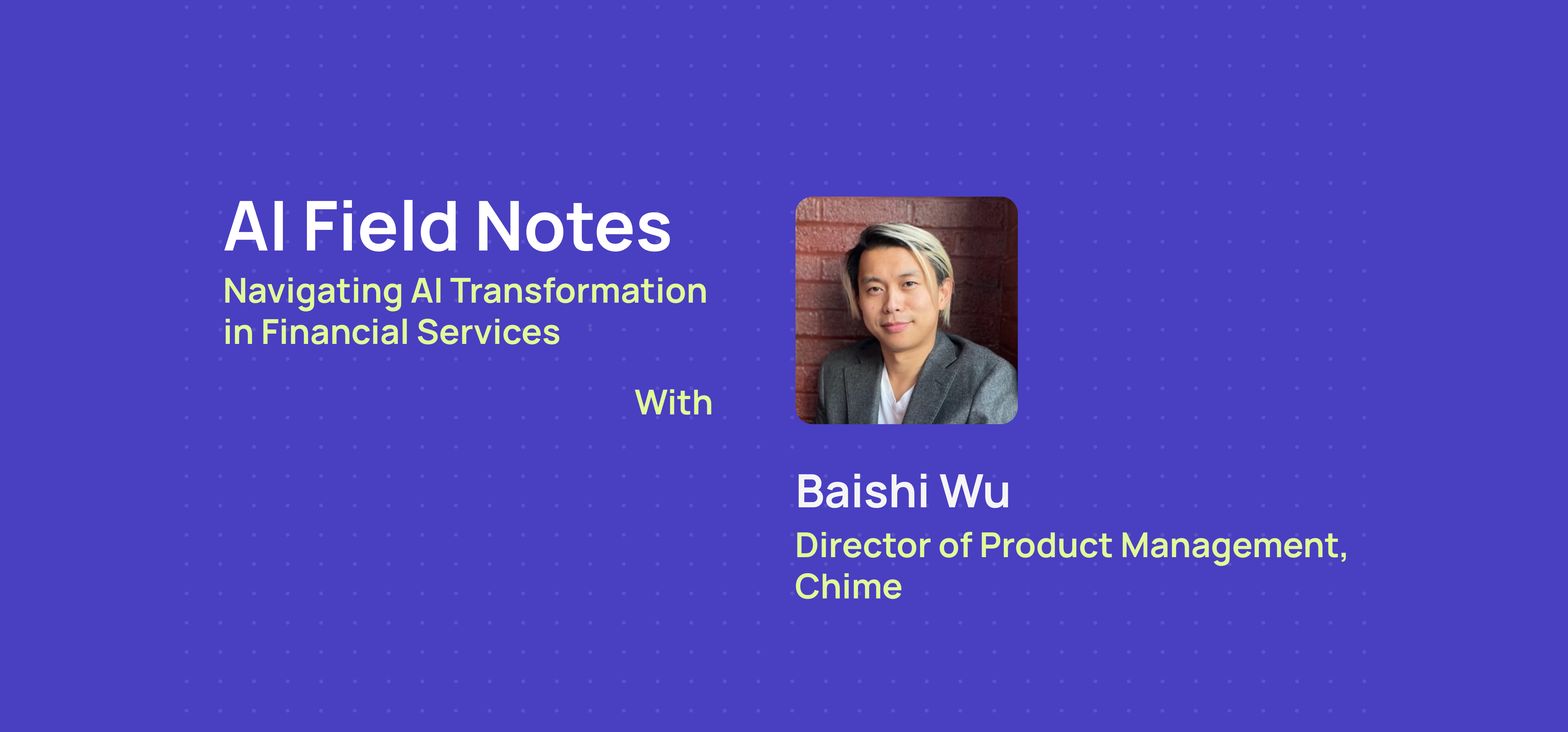
Baishi Wu oversees Chime’s cards organization across debit and credit products, collaborating across product, credit risk, and data science to optimize customer experiences from access to authorizations. In a recent interview with Taktile’s Co-Founder and CPTO Maximilian Eber, Baishi takes listeners under the hood of AI-driven underwriting at Chime.
He shares what makes underwriting at Chime so unique, how the team uses AI to accelerate decisions for customers today, and his POV on the next big opportunity for AI in underwriting.
Chime’s secret sauce for credit underwriting
Baishi highlights owning the primary account relationship as Chime’s main differentiator in credit underwriting. He shares that when you’re the account where 100% of someone’s cashflow lands, you have a massive advantage over lenders who only see a slice.
“As long as you continue to be the source of a customer’s cash flow, you have the ability to underwrite more effectively than most players in the market.”
When lenders rely on bureau data, they’re only accessing a single moment in a borrower’s history. Cashflow data is constantly evolving: Baishi’s team can see it in real time and continually adapt decisions. However, he notes that lenders often make the mistake of using cashflow data as a snapshot insight:
“When people have traditionally looked at cashflow data from an open banking perspective, they took the analog of how people use credit data and tried to apply it for cash flow data: We'll look at a single point in time, see some historical transactions, and try to underwrite you on the spot.
But the key aspect of what you want to do with cashflow data is to see it as many times as you can and influence your decisions on a continual basis.”
Get the latest on AI in financial services, straight to your inbox.
Deciding when customers graduate to the next credit level
Chime’s access to continuous customer data is a huge strategic advantage. But it also adds complexity when it comes to adjusting customers’ credit limits throughout their journey.
“It's not a simple A-B test where a single moment influences what you need to do over time.”
When Chime wants to expand access to credit, Baishi’s team uses champion challenger testing to see whether they can offer more to customers who wouldn’t normally have expanded access.
Sounds simple.
But in Chime’s case, customers aren’t one-time borrowers; they’re repeat users with constantly evolving needs and circumstances. “It's not a simple A-B test where a single moment influences what you need to do over time,” explains Baishi. “It's a series of tests based on a variety of tenure and experience, and all of that makes it much more complex.
But at the heart of it, this process follows a champion challenger model where we’re trying to figure out how we can push the envelope in terms of what we can offer our customers.”
Accelerating credit decisions with AI when using complex data
With so much complex information to parse through, Baishi has seen AI accelerate his team’s ability to turn raw data into actionable insights.
First, AI can break down data silos between cross-functional teams. In the past, credit risk, data science, finance, and product teams might have worked with separate, distilled information. With AI, every team can have access to the full picture and make confident decisions faster, no matter their level of technical expertise.
Second, AI can function as a “risk analyst in a box,” which can quickly turn data into usable insights when paired with human judgement.
“When you have a dataset that is difficult to mine, you can let AI quickly summarize and bring the pieces together. Then, layer in your human judgment to decide what actually is significant. This way, you can much more quickly take data sets that you're not sure are worth your time, glean an insight, and decide if it has the potential to slow up risk.”
The biggest AI automation opportunity in credit underwriting
Looking ahead, Baishi sees model validation as the biggest opportunity for AI-driven automation in underwriting. While building a credit policy is one part of the process, making sure the model functions properly and is compliant is the part that actually takes a long time.
If you deploy more than thirty features, explains Baishi, you’d need to create documentation for each one. He argues that AI can automate more of that governance process:
“You can design a credit model based on how you think it should actually work, then automate the governance process with AI. Less tedious work in between, more direct conversation between risk and compliance.”
The idea is once AI can automate the governance side, teams can focus on innovation.
“Creating a policy that can improve over time takes a lot of effort and is really complex. With AI, you can really increase the pace of how quickly we can create new ideas in this space. That’s the real way you can win: being able to focus on the important, critical work—and making the work that ‘checks the boxes’ much easier to do.”