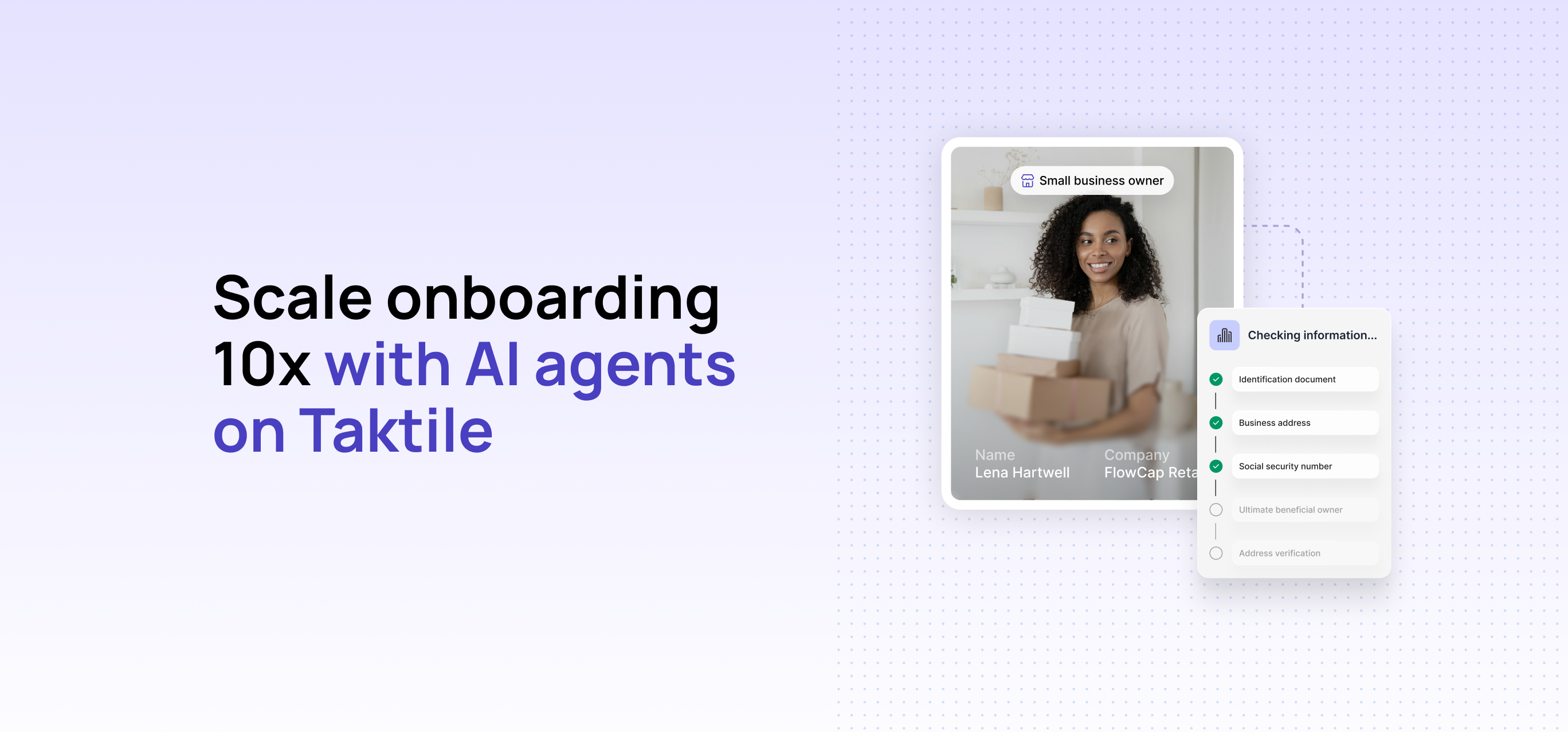

Onboarding is one of the most manual workflows in financial services. The result is a familiar bottleneck: analysts get stuck in tedious document reviews and adverse media scans, while customers wait days for decisions they expected in minutes.
Today, leading financial institutions are turning to AI to create a better experience for both onboarding teams and the customers they serve.
With the latest models, Al agents can now interpret unstructured documents, follow complex policies and processes, and make nuanced judgments as a human would—sometimes with even greater accuracy.
The first step to transforming your onboarding process with AI is understanding exactly where agents can make an impact, and how to ensure they add real, reliable value for your team.
What's changed: how agentic AI helps teams automate tedious work
Before we dive into the main areas where agents can benefit your onboarding strategy, it's helpful to understand why the latest advances in AI have changed the game.
Onboarding has long resisted extensive automation for a reason. Traditional rules engines can only automate steps where the outcome is determined based on structured data.
For example, rules engines can read clean fields and flag an application that misses a fixed threshold. But they can’t interpret messy documents, spot missing paperwork, or untangle complex ownership structures.
The breakthrough of agentic Al is that it can handle the tasks that rules engines aren't built for. In onboarding, an agent could verify customer identity and run adverse media searches, providing teams who have battled with the limits of automation with a powerful new tool.
While the opportunity is clear, the path from concept to deployment remains opaque for
many teams. To make this journey practical, we’ll look at two layers of an AI-driven onboarding strategy:
- Identify your opportunities: Develop your understanding of the problems agents can solve, and zero in on the highest-impact areas to deploy them within your teams and systems.
- Understand the infrastructure: Learn how to orchestrate agents for responsible governance and effective performance in production.
Layer one: identifying where AI can accelerate your onboarding process
Onboarding bottlenecks tend to cluster in the investigation-heavy steps—where teams gather, cross-check, and interpret messy information. That’s where agents can take on the repetitive work and surface clear findings for reviewers.
Here are four areas where we've seen agents deliver measurable impact for teams:
Application completeness checks
Teams often begin the onboarding process by confirming that every application arrives with the required documents and data.
Without agents, reviewers check each submission by hand. Incomplete applications create friction for customers, who might learn something is missing after a few days, and the back-and-forth consumes reviewer time before any real analysis starts.
With agentic AI, an agent validates completeness before a file reaches the queue, flags missing or inconsistent information, and prompts the customer to resubmit. Reviewers receive files that are already complete, so they spend their time on assessment rather than chasing paperwork.
Business ownership and UBO mapping
When onboarding teams understand the individuals who ultimately own and control a business, they can more accurately risk-score a corporate customer.
Manually, analysts must piece together ownership structures from various documents and records, which can be a slow and error-prone task when organizations are layered or opaque.
In AI-driven onboarding, an agent maps a company’s ownership structure and identifies Ultimate Beneficial Owners from the provided records, surfacing complex arrangements and leaving analysts with a clear picture to review.
Sanctions and watchlist screening
Checking customers against global sanctions and watchlists helps protect your business from major regulatory fines by ensuring prohibited entities don’t enter your ecosystem.
Previously, teams would spend much of their time clearing false positives that stem from loose name matching.
Now with agents, AI capabilities like fuzzy matching and intelligent filtering can reduce false positives, helping analysts focus only on the matches that warrant a closer look.
Adverse media screening
Adverse media screening helps teams uncover hidden risks, such as a customer’s reputational controversies, that structured databases can miss.
This can be an inconsistent, time-consuming process in which analysts search across countless media sources, read through results, and decide which signals matter.
To do this faster with AI, an agent can scan thousands of global sources for adverse mentions and summarizes findings by relevance and risk.
Put together, agents can quickly carry a case from application to approval—shrinking cycle times dramatically. But once you add AI into the mix, there are still four essential building blocks that ensure every decision is compliant and geared toward your team’s goals.
Layer two: the building blocks that make AI successful
A successful AI-driven onboarding strategy requires good data, clear policies, human judgment on complex cases, and a way to monitor your decisions.
Together, these elements make the difference between AI that breaks the system, and AI that adds real, measurable value.
1. Data foundations for consistent decisions
At the base of every solid onboarding decision is solid data: complete, accurate, and consistent across the places your team works. That foundation matters even more with AI: an agent can’t “fill in the blanks,” and it will only be as reliable as the information it can access.
Strong onboarding brings customer inputs, third‑party signals (e.g., watchlists), and internal systems into one connected view, backed by clear definitions and ownership, so agents and reviewers operate from the same source of truth.
2. Governance that keeps agents controlled, auditable, and compliant
Governance is what makes onboarding decisions defensible, especially in regulated environments. AI raises the stakes because agent behavior can be probabilistic, which means you need guardrails to keep outcomes consistent and actions tightly bounded.
Strong onboarding governance can combine:
- permissions to constrain data access and allowable actions,
- policy encoding to enforce internal and regulatory requirements in workflows and agent instructions,
- and a clear split between rules for deterministic thresholds and agents for investigative, multi-step reasoning.
3. Human-in-the-loop review for judgment-heavy decisions
Human-in-the-loop review matters because some onboarding calls are inherently judgment-based, and that’s doubly true with AI. Models can be persuasive even when they’re inaccurate, and the hardest cases tend to be the ones where policy requires interpretation.
As you build your AI-driven onboarding strategy, we recommend creating a clear policy around what’s automated and what requires expert sign-off. With that in place, you can configure agents to escalate high-risk or ambiguous cases with the full context reviewers need: customer history, key signals, and the agent’s reasoning and evidence.
4. Monitoring and ongoing risk oversight
Monitoring is essential in AI-driven decisions because unseen changes in the background, such as sudden spikes in a customer’s transaction volume, can cause decision quality to degrade. Additionally, regulators require a transparent audit trail of all decisions, whether AI or human-driven.
Given that, AI-driven onboarding teams build dashboards that track agent and human actions, as well as ongoing shifts in data, customer behavior, and evolving fraud patterns. This provides teams with a way to understand, explain, and improve their onboarding decisions over time.
Bringing it all together
Building a successful AI-driven onboarding strategy doesn’t rely on model capability, but teams being able to turn it into a working system. When you identify the investigation-heavy steps where agents earn their place, then build on the fundamentals that keep those decisions reliable and controlled, the work that once piled up starts to move.
What's left is the version of onboarding teams have always wanted but rarely had the tools to reach: legitimate customers cleared in hours, complex cases given the attention they deserve, and every decision ready to stand up to scrutiny.
Explore more insights on AI in financial services.
Frequently asked questions (FAQs)
Q: How is an AI agent different from traditional onboarding automation?
A: Traditional rules engines automate steps where the outcome is pre-determined and the data is highly structured, like flagging an application that misses a fixed threshold. An AI agent can interpret unstructured information, reason across inconsistencies, decide which steps to take, and adapt as it goes, which is what makes it suited to the investigative, judgment-based work that fills onboarding.
Q: Where in the onboarding process can agentic AI make the biggest difference?
A: The strongest opportunities are in time-consuming, investigation-heavy steps that depend on reading and reasoning over unstructured information. In onboarding, that commonly includes application completeness checks, business ownership and UBO mapping, sanctions and watchlist screening, and adverse media screening.
Q: What do you need in place for AI-driven onboarding to actually work?
A: AI succeeds on the same fundamentals great onboarding always relied on: connected data that gives agents a complete picture, governance that keeps agents within clear policies and guardrails, human oversight on the decisions that require judgment, and monitoring that tracks every decision over time. Agents deliver value when they're embedded in a system built on these building blocks, not used as standalone tools.
Q: How do teams keep AI agents under control in a regulated environment?
A: Through governance built on guardrails that limit what an agent can do, internal and regulatory policies encoded into both the decision logic and the agents themselves, and a deliberate split between rules for fixed decision points and agents for multi-step reasoning. Because agents are probabilistic rather than fixed like rules, these controls are what keep decisions consistent and compliant.
Q: Is AI-driven onboarding auditable?
A: It can be, when monitoring is built in. An effective approach keeps explainable audit trails for every agent action, recording the data and tools used to reach each decision, alongside performance tracking to catch any drift below the human baseline. Combined with clear records of human decisions, this creates the audit trail teams need to demonstrate compliance.