AI 5 min read
Risk is a product decision: Peter Lu on how Monzo Bank approaches product and risk as one

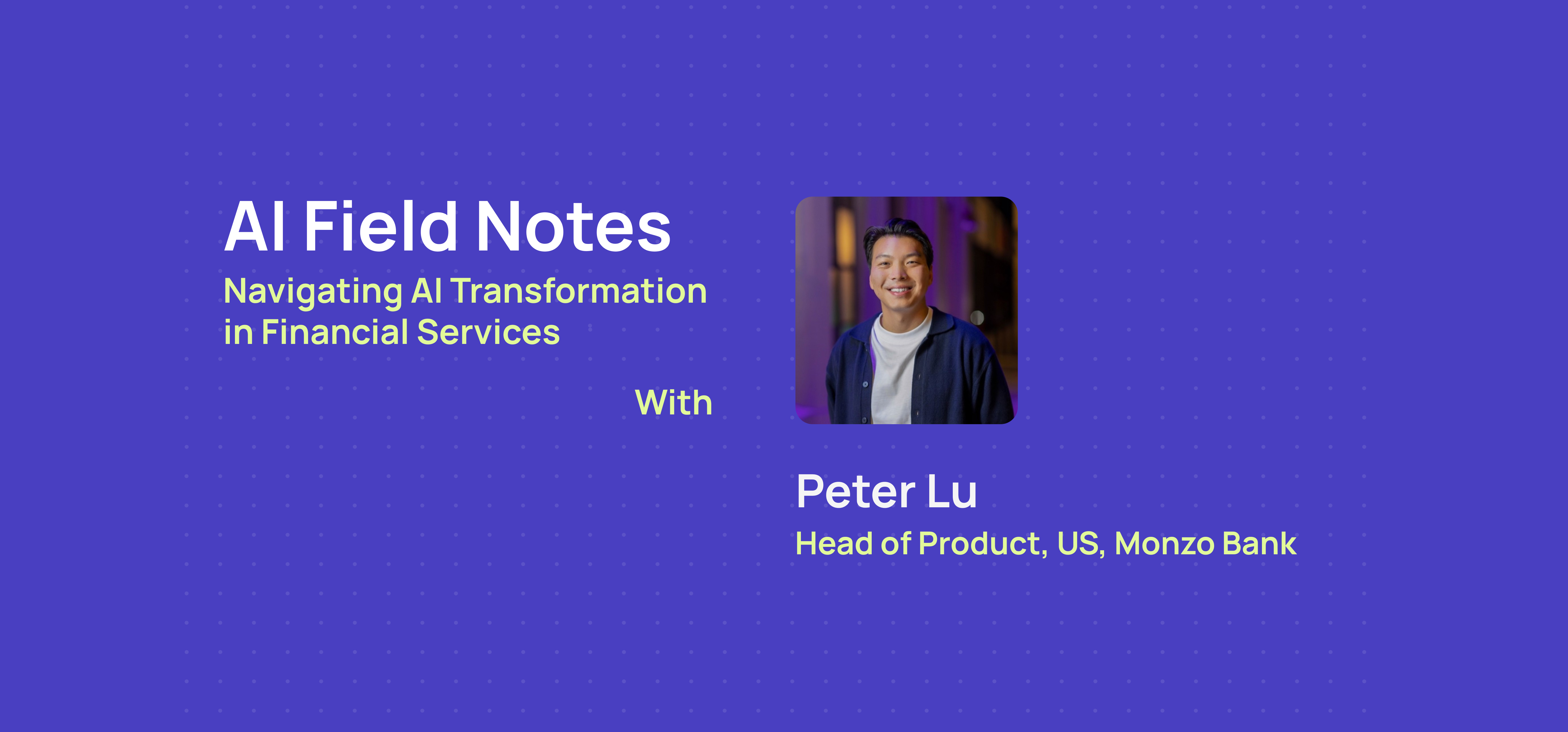
Peter Lu has spent his career scaling consumer fintech products across Canada and now the US. As Head of Product for Monzo Bank in the US, he's leading product strategy for the next phase of Monzo's growth—following the bank's $610M raise to fuel its US expansion.
Talking with Maximilian Eber, Taktile Co-Founder and CPTO, Peter shares how Monzo Bank approaches risk and product as one discipline. He explains why he expects his product managers to track risk metrics alongside NPS, and where risk itself can become a competitive advantage in financial services.
How Monzo Bank designs product and risk as a single strategy
Peter emphasizes that risk, product, and other cross-functional teams share collective responsibility. As he puts it, "Product managers need to understand how decisioning is made, and [...] the risk team needs to understand the design of the product and the intention of the product strategy."
He illustrates this with a specific example: Monzo targeting expats in the US.
The expat customer profile shapes everything downstream, Peter explains. Newcomers may not have US credit scores or a digital footprint, and the data sources available to underwrite them can look completely different from those available for established US consumers.
These nuances influence the entire underwriting strategy—from the data partners the team selects to the product flows users see at signup.
In Peter's experience, product and risk have to work together from day one; otherwise, you could end up with an incredible product that isn’t viable for your ideal ICP.
"[Decisions] have to be cohesive," he continues, "and they need to be from the top, around what is the Ideal Customer Profile and…how are we trying to go after that market."
Get the latest on AI in financial services, straight to your inbox.
Why product managers benefit from owning risk metrics like default rates and NPS
Where this collaboration becomes most concrete, in Peter's view, is in the metrics each team is expected to own.
Product managers typically focus on inputs like NPS scores, active users, and conversion rates, which are signals about how customers experience the product. Risk teams often track a different set: approval rates, default rates, and chargeback rates, which signal how the business is exposed to loss. Peter's view is that holding these dashboards apart can leave both teams operating with incomplete information.
For fintech specifically, Peter believes in building product organizations that are lean but empowered to execute. "In order for [product managers] to be highly-levered in decision-making, they must understand all the inputs of the P&L,” he explains.
In other words, the scope of product ownership is widening. PMs increasingly need to watch risk metrics like default and approval rates. And as AI takes over more of the decisioning work, the line between a "product KPI" and a "risk KPI" is blurring.
How Peter’s team used a UX hack to navigate risk in a new market
Peter shares a powerful illustration of the synergy between risk and product from his own career—when his team set out to launch Canada's first true credit-building product.
In the US, fintechs can offer fully securitized credit-builders, where the lender takes essentially no risk. In Canada, however, credit bureaus don't always allow fully securitized products to count toward credit-building. To meaningfully move someone's credit score, Peter’s team needed to issue real, unsecured lines that were large enough to matter, but with users whose credit profiles ranged from subprime to credit-recovering.
Peter's team made an unconventional bet. By framing the product as a credit-builder rather than a credit card, the team aligned the design with what users actually wanted: a tool to build credit, not a line to spend from. With that framing in place, users had less reason to draw on the credit line, which kept utilization, and therefore risk, low.
"The risk we took was a UX risk," Peter explains. His team extended roughly $250 of credit per user without applying the usual underwriting checks, betting that the product's design, rather than risk filters, would keep most users from actually drawing on the credit.
The result was default rates under 5% and a margin-positive product that genuinely served users in credit recovery.
What Peter is watching next: How AI will redefine consumer product design in fintech
Peter is thinking deeply about what AI means for fintech, and two threads of his thinking come through with conviction.
First, the form factors that underpin consumer product design are shifting.
"Consumer form factors probably change […] once every 10 to 15 years," Peter observes, pointing to the move from desktop to mobile, and now to chat-based interfaces like ChatGPT.
This shift raises an existential question for fintech infrastructure and data providers: how do they avoid being disintermediated, or cut out of the value chain, when AI agents sit between them and the end customer?
Peter's practical takeaway: bet on the form factor first, and the right product follows."The shape of AI products is beholden to the form factor of the consumer,” says Peter. “If you make […] the right bet on form factor, you'll probably make the right bet on the kind of product you build."