AI 5 min read
Automating risk decisions with AI: Alexandra Lynn Hollombe on balancing efficiency with human judgment

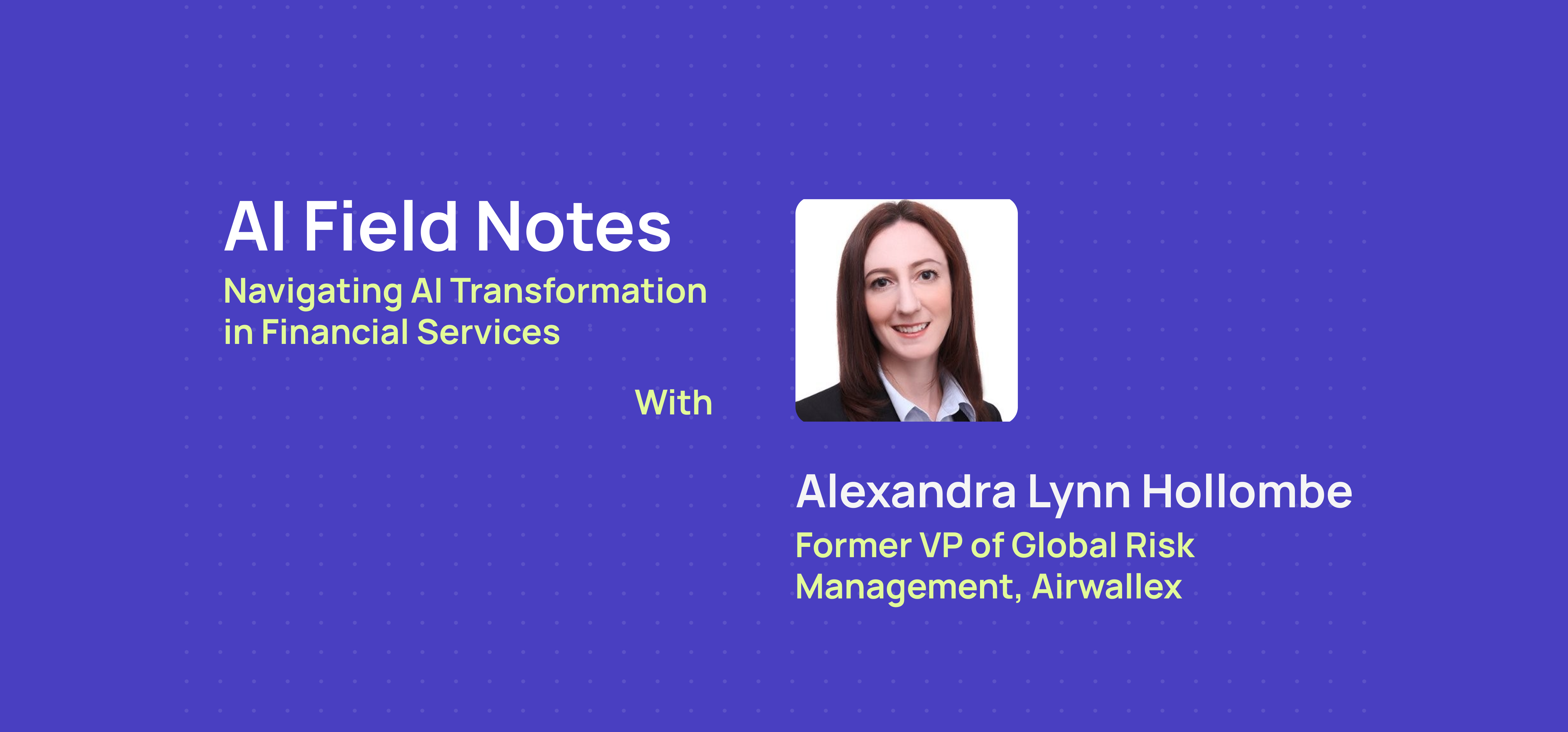
Alexandra Lynn Hollombe has built an impressive career in risk management, leading teams at established institutions such as American Express and fast-moving fintechs like Stripe. Most recently the VP of Global Risk Management at Airwallex, Alexandra brings a unique perspective on how risk evolves as companies scale.
In a conversation with Maximilian Eber, Taktile’s Co-Founder and CPTO, Alexandra shares her take on the path forward for AI in risk management. She explores where AI is driving the most value in decision-making, the human side of risk, and her 2026 predictions for what’s next in financial services AI innovation.
Where AI is transforming risk management—and when human judgment still matters
Many conversations about AI last year focused on differentiating hype from reality. But there are some things AI really can do better than humans.
“When the outcome is deterministic [...] like KYC complete, KYC not complete, AI can definitely [automate] that.”
For instance, Alexandra explains: “AI is really good at image matching. It’s really good at saying ‘This looks like a fake document’, much more than an analyst who […] probably needs more coffee when they’re looking at these things.”
Beyond automating individual tasks, Alexandra suggests that AI can enable organizations to automate entire decision workflows in cases where the result is usually predictable. “When the outcome is deterministic [...] like KYC complete, KYC not complete with a somewhat complicated rule set, I think AI can definitely do that. I have no qualms about fully automating that system with quality control and monitoring.”
However, for decisions where “the risk of being wrong is really high”—such as loaning someone two million dollars or more—Alexandra argues that AI doesn’t eliminate the need for human judgment.
In these complex cases, she sees AI as more of a tool than a catch-all solution. “AI can be a fairly good partner, but they're a partner,” she observes. “They are not making those decisions by themselves.”
Get the latest on AI in financial services, straight to your inbox.
Putting people first: Why risk is fundamentally human-centered
When it comes to shaping how to manage risk, AI is one piece of the puzzle. According to Alexandra, people’s attitudes and personalities are what really shape a company’s overall approach to risk management.
In any organization, Alexandra notes, you'll find people with many different perspectives sitting around the same table. “Some people are pessimistic, some are risk averse, some are the shoot-first-and-ask-questions-later kind of people.”
While AI can be a useful tool in executing risk strategy, it’s the organizational culture that defines risk tolerance and where an organization is willing to push the boundaries.
“AI isn’t going to help us with formulating how we’re going to make [risk] decisions. We ultimately need to form an identity or a brand…that says, ‘This is the risk that we’re acceptable with’ and take the leap.”
What’s next: 2026 predictions for AI in financial services
Looking ahead, Alexandra shares several areas where she believes AI could change the game for financial services in 2026.
“AI does a great job of incorporating a lot of different data sources.”
“Specifically for risk management, AI will become core infrastructure. [...] There’s going to be a lot more emphasis on high data quality, data architecture, and data governance, which I think is just a fantastically good thing. I think you can’t really make any decisions without it.”
Alexandra also predicts more accurate credit risk scoring as a result of faster data orchestration with AI. “AI does a great job of incorporating a lot of different data sources. And one of the challenges that we’ve always had with credit risk scoring is that it’s not available for different segments, or it’s very lumpy in terms of the availability of data.
“Once we have AI to help us with that, I think it'll be a big leap forward in terms of how we make credit decisions.”
Wrapping the conversation, Alexandra re-emphasizes where risk teams have seen proven results with AI: efficiency, decision accuracy, and cost reduction. We’re excited to see how inspiring leaders like Alexandra continue to explore new frontiers with AI in financial services.