KYB automation has traditionally worked best where checks and responses are well defined. The harder part is handling incomplete, inconsistent, or contextual information, which still pulls onboarding teams into manual review and investigation.
And that friction is felt by customers. EY research found that 42% of SMEs were dissatisfied with the speed of the onboarding process, while 36% were dissatisfied with the degree of automation.
Agentic AI is starting to change that by moving more investigative work earlier in the process, so straightforward cases can move faster and human reviewers can focus on where their judgment matters most.
Key takeaways
- Start with the work, not the technology. Separate deterministic checks from investigation and genuine judgment before deciding what to automate.
- Let risk and complexity determine the path. Low-risk cases can receive more automation, while medium- and high-risk cases receive additional investigation or human review.
- Use rules, AI, workflow, and human expertise together. Each is suited to a different part of the onboarding process.
- Design human review into the workflow. The goal is to give reviewers a better-prepared case, not simply remove them from the process.
- Test and improve continuously. The right threshold between automation and human review should be tested rather than assumed.
Step 1: Map your current onboarding workflow
Start with what actually happens today.
Walk through recent KYB cases and look at the work required at each stage.
Some tasks are largely deterministic: retrieving data, checking whether required information is present, or applying predefined policy rules.
Others are investigative: resolving contradictory information, understanding a complex ownership structure, or determining whether an adverse media result is relevant.
And some genuinely require human judgment.
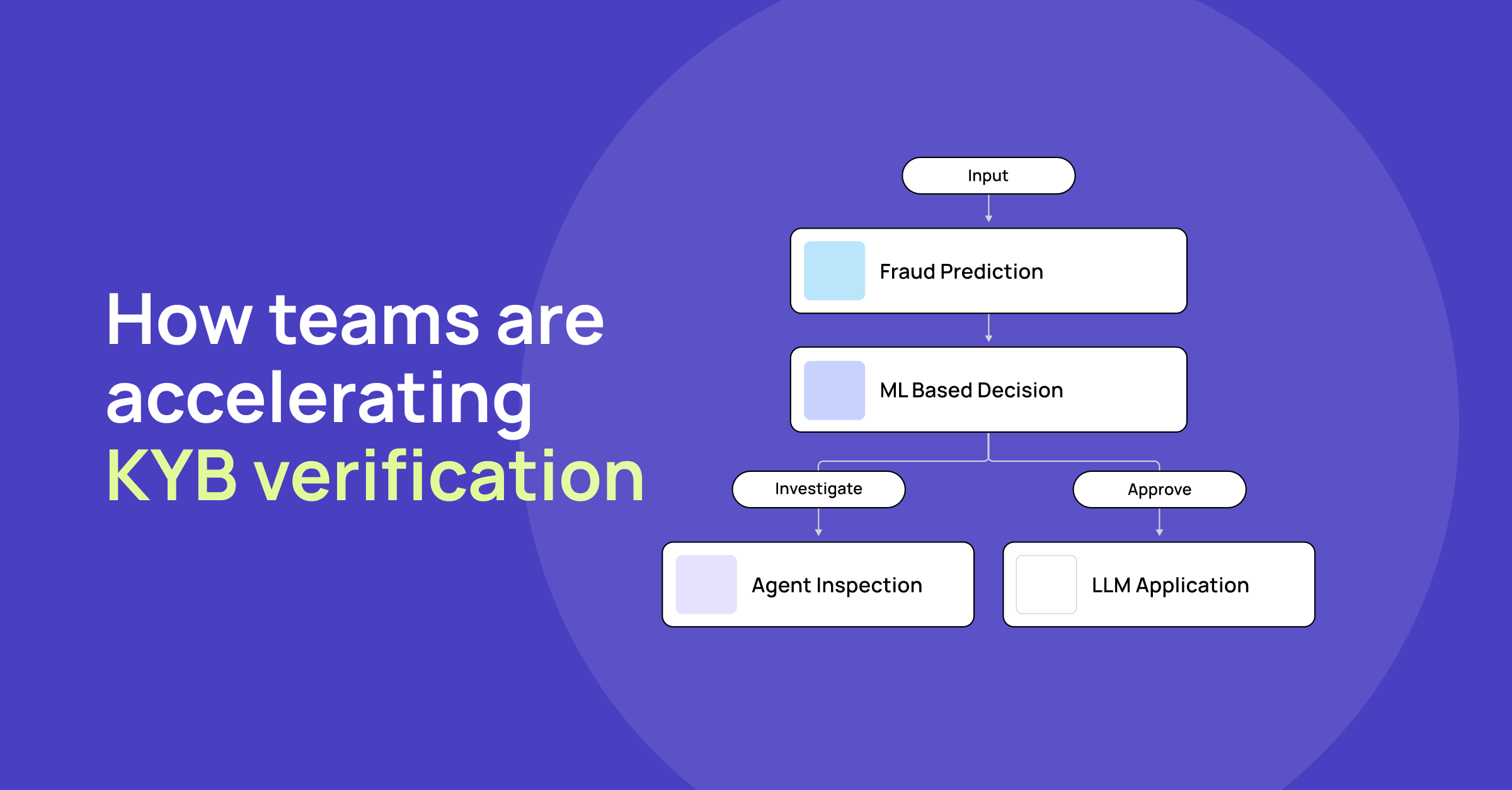
A useful way to approach this is to look at which capability is best suited to each part of the process.
Pay particular attention to the investigation-heavy work. These are often the steps where teams gather, cross-check, and interpret information manually and where newer AI capabilities can make the biggest difference. Taktile explores these opportunities in more detail in its guide to building an AI-driven onboarding strategy.
Step 2: Define risk tiers and routing
Not every customer needs the same onboarding journey.
Once the workflow is mapped, explore which cases could move through automatically and which may benefit from additional investigation or human review.
A simple starting point is three risk tiers:
- Low risk: Straightforward applications with complete information, simple ownership structures, and no material risk signals. These may be suitable for a high degree of automation.
- Medium risk: Applications with missing information, more complex structures, or signals that require further investigation. These can trigger additional data checks or AI-driven investigation.
- High risk: Cases with significant complexity or risk signals that require closer attention. These can move to a human reviewer with the relevant evidence already assembled.
The exact criteria will depend on the institution’s policies, risk appetite, markets, and customer base.
A useful way to think about this is to make the routing logic explicit.
Rather than treating onboarding as simply automated or manual, teams can combine rules, data, AI agents, and human review in different ways depending on the risk and complexity of each case.
Step 3: Automate business verification and data enrichment
Business verification is one of the more natural places to start.
The core task is confirming that the business exists, that the information submitted is consistent with trusted sources, and that you have enough information to continue the assessment.
Much of that work can happen automatically.
Data providers can retrieve company and registration information, ownership data, and other relevant signals. The workflow can then combine those inputs rather than asking an analyst to gather and compare them manually.
The harder part is what happens when the data does not give you a clear answer.
Coverage varies across markets. Information may be missing. Two sources may disagree.
Instead of allowing the application to stall, the workflow can query another source, request additional information, trigger further investigation, or route the case for review.
AI can extend this further. Taktile’s Business Verification Agent, for example, retrieves registry, ownership, and documentation data and compiles the findings into a structured report.
Step 4: Automate beneficial ownership and UBO investigation
Ownership is where KYB can quickly become more complex.
A business with a simple ownership structure may be straightforward to assess. Multiple holding companies, cross-border entities, incomplete records, or conflicting information can turn the same task into a significant investigation.
Traditionally, analysts may need to piece together information from multiple documents and sources to understand who ultimately owns or controls the business.
AI can help move more of that work earlier in the process by gathering available ownership information, mapping relationships between entities and individuals, identifying potential Ultimate Beneficial Owners (UBOs), and surfacing gaps that still need attention.
This information also matters from a regulatory perspective. FATF’s beneficial ownership standards call for authorities to have access to adequate, accurate, and up-to-date information on the true owners of companies.
Where the ownership structure cannot be resolved confidently, the workflow can instead request more evidence or move the case to human review.
Step 5: Automate sanctions, watchlist, and adverse media investigation
Screening creates a similar distinction between identifying a signal and understanding what it means.
A potential match does not necessarily tell a reviewer whether they have identified the correct person or business. Likewise, an adverse media result may require context before it becomes useful to a decision.
This is where AI can extend traditional screening workflows.
An agent can investigate potential matches, compare entity information, gather supporting evidence, and summarize what remains unresolved before a case reaches a reviewer.
For adverse media, it can also search and structure information from unstructured sources, helping the reviewer understand not just that something was found, but why it may matter.
Entity disambiguation, the quality of the underlying sources, and clear, structured outputs remain important. The goal is not simply to produce fewer alerts. It is to make each alert easier to investigate.
Step 6: Build manual review gates for edge cases
One way to think about automation is not as a replacement for human review, but as a way to make that review more focused.
A simplified onboarding flow could look like this:
- Data establishes the known facts.
- Rules apply deterministic policy.
- AI investigates what sits behind ambiguous or unstructured information.
- Workflow coordinates what is still needed.
- A human applies judgment where necessary.
For a medium- or high-risk case, that means the reviewer should receive the relevant verification results, ownership information, screening findings, and reasons for escalation together.
Instead of reconstructing the case from the beginning, they can focus on the unresolved question.
That is the more interesting opportunity for onboarding teams: not removing people from every decision, but reducing how much investigative work has to happen before their expertise is actually needed.
Step 7: Connect routing, policy changes, and audit trails
Once a case has completed the required checks, the workflow needs to determine what happens next.
Depending on the institution’s policy and the individual case, that could mean continuing automatically, requesting more information, or moving the case into human review.
Whatever the outcome, the path to that decision should remain traceable.
Giving teams visibility into which data was used, which checks ran, which rules were triggered, and why a case was escalated can make the decision path easier to understand and improve.
One example is Capchase. As the B2B fintech expanded internationally, its KYB workflows needed to support different markets, data sources, and policy requirements. After moving its decisioning workflows onto Taktile, Capchase reported a 50% decrease in processing time while using more data sources, alongside a 99% reduction in the time required to make policy updates. Changes that previously took weeks could be tested and launched in minutes.
Step 8: Monitor, test, and iterate
An automated onboarding workflow is not a set-and-forget system.
Once automation is introduced, a few measures can help teams understand how the workflow is performing.
Useful measures include:
- How many cases move through each risk tier
- How many applications require manual review
- Screening false-positive rates
- Manual review turnaround times
- How often reviewers disagree with or materially change an automated recommendation
Before expanding automation, teams can also test new approaches against historical applications.
Does the automated process identify the same relevant evidence? Does it miss anything material? Where does the reviewer still add information that meaningfully changes the outcome?
Taktile, for example, allows teams to back-test agents against historical data before deployment and route uncertain cases into Case Manager with the relevant context attached.
Those results give teams something concrete to work from.
The goal is not to arrive at one universal model for KYB. It is to keep learning which capability is best placed to handle each part of the process.
Automating KYB is ultimately an orchestration challenge
The next stage of onboarding automation is less about replacing reviewers with AI and more about matching each capability to the work it is best suited for.
Data and rules can handle known facts and deterministic policy, AI can support investigation, and human expertise can stay focused on decisions where judgment matters most.
Done well, straightforward cases move faster, complex ones arrive better prepared, and teams stay in control.
Ready to explore your onboarding AI use case?
Frequently Asked Questions (FAQs)
What steps in onboarding can be fully automated versus requiring human review?
Tasks such as data collection, business verification, application completeness checks, and screening are strong candidates for automation. Complex ownership structures, ambiguous findings, or cases requiring contextual judgment may still benefit from human review.
How can AI reduce manual work in KYB reviews?
AI can gather and structure information from documents and external sources, investigate inconsistencies, and summarize findings. This helps reviewers spend less time assembling a case and more time on decisions that require judgment.
What data sources are typically used in automated KYB verification?
KYB workflows commonly combine business registries, ownership data, sanctions and watchlists, adverse media sources, and commercial data providers. The exact mix depends on the markets, customers, and policies involved.
How can banks change KYB policies without relying on engineering teams?
Decision platforms with no-code or low-code policy can give onboarding and risk teams direct control over rules, thresholds, and routing logic. Changes can then be tested and updated without rebuilding the workflow or waiting for engineering support.
What off-the-shelf AI agents exist for onboarding tasks like adverse media screening?
Pre-built agents are available for tasks such as business verification, document review, application completeness checks, sanctions screening, and adverse media investigation. The important consideration is whether they can produce consistent, traceable outputs that fit into the wider onboarding workflow.